
Every sovereign state on the map, as well as territories with their own administration, such as Greenland, Puerto Rico or Hong Kong. The smallest micro-states, such as Monaco or the Vatican, appear on the map but cannot be played.
Geoplanetical
What you can do
Rewrite labour laws. Negotiate a defence pact. Run a covert operation. Establish a colony on the Moon.
Questions about the game? Read the FAQ ↓ Looking for the controls? Open the player wiki ↗01 / Politics & laws
Rewrite the rules of the country
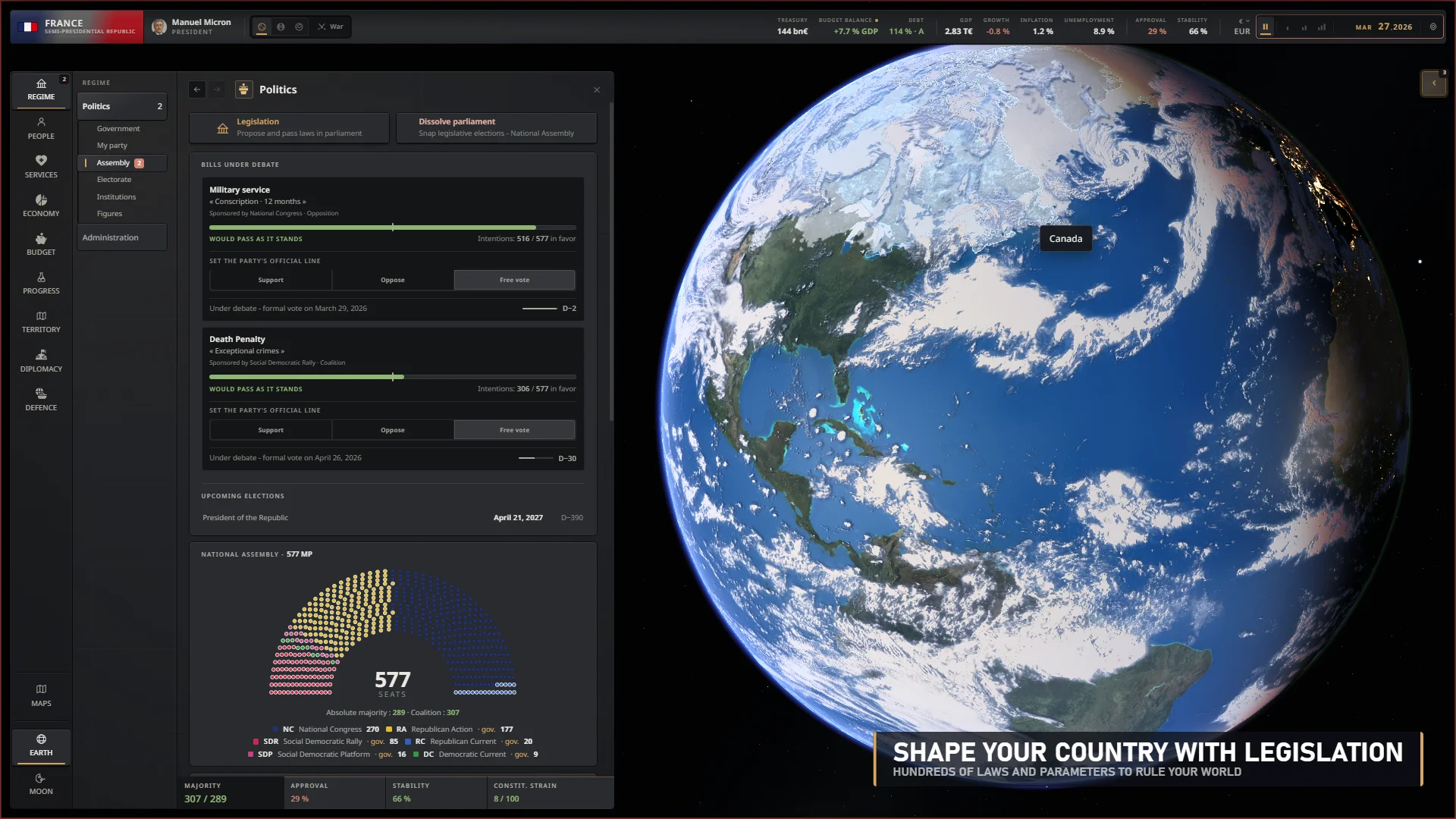
- Set the minimum wage, working week, paid leave and retirement age.
- Set pension indexation, an old-age minimum and child-benefit amounts, eligibility and age limits.
- Change abortion law, the death penalty, drug laws, asylum rules and the place of religion in public life.
- Reform electoral rules, term lengths, term limits and the powers of the executive.
- Table bills, inspect voting forecasts, follow debates and withdraw a proposal.
- Set your party’s voting line: support, oppose or a free vote.
- Call early elections when your office has that power; handle assent or veto where the constitution requires it.
- Propose adding or removing an upper chamber, changing Parliament’s powers, or altering veto and judicial-review rules.
- Change how a chamber is selected, its voting system and whether seats renew together or in parts, through the constitutional procedure.
- Ask another party leader to support a bill through Cablegram; an accepted request changes their party’s voting line.
02 / Elections & government
Win seats. Defend your programme.
- Campaign for a chamber or an elected executive office, each with its own electoral calendar.
- Raise party funds, recruit activists and commit resources to campaign operations.
- Announce up to three commitments on laws, taxes, spending or electricity capacity, with targets to fulfil.
- Follow full or partial chamber renewals, coalition formation and any required investiture.
- Track your promises through the mandate. Keeping or breaking them affects your party’s credibility and influence.
- Continue in opposition after losing government and use the parliamentary powers your party retains.
- Table a no-confidence motion when your party has seats and the constitution allows it.
- Ask ministers for advice in Cablegram and open the policy file behind their recommendation.
03 / Migration & communities
Set admission rules. Follow who comes and goes.
- Raise or lower the annual cap on regular immigration and track actual admissions.
- Choose asylum rules covering access to protection, appeal rights and detention limits.
- Compare the age and qualification profiles of arrivals and departures, including the groups leaving and their destinations.
- Follow communities, integration, naturalisation and your country’s diaspora abroad.
04 / Society & labour
See who is struggling. Negotiate with their representatives.
- Inspect social groups’ incomes, taxes, wealth, satisfaction and militancy.
- Compare the groups affected by living costs, unemployment, housing and public services.
- Meet union representatives and inspect active demands, strike participation and disruption.
- Offer a compromise or meet a demand, then implement the agreed budget measure or legal change.
05 / Housing
Set the rules for rents and home loans.
- Choose free, income-indexed or capped rents.
- Limit increases when eligible mortgages reach their next scheduled rate reset.
- Launch a social-housing programme and review its cost, construction time and provincial deliveries.
- Compare housing shortages, vacancies and the costs faced by tenants and homeowners.
- Fund thermal renovation, cooling, heat pumps and climate shelters; adjust heating, cooling and emergency protection during extreme weather.
06 / Civil unrest
Choose your response to the streets.
- Inspect a movement’s demands, participants and the groups behind it.
- Facilitate and protect a protest, contain it or order its dispersal.
- Authorise an armed crackdown or deploy the military after reviewing the risks.
- Follow clashes, casualties and the pressure on public support and stability.
07 / Budget & taxes
Decide who pays, and for what
- Edit income-tax brackets. Set employee and employer contributions separately, with assessment caps and relief for low wages.
- Set a personal allowance, index tax thresholds to wages or prices, and tax capital income through the same bands, a separate rate or an exemption.
- Set VAT rates and assign individual products to VAT categories.
- Change corporate, wealth, inheritance, property, carbon and customs taxes.
- Adjust public spending and public-sector pay in a shared budget proposal.
- Compare the revenue, spending and balance forecast before applying the reform.
- Issue debt or repay it. Set the policy rate when your government controls it, or restore central-bank independence.
- Review money creation where your monetary system permits it, or a voluntary debt default, with their costs and consequences.
08 / Business & banking
Intervene in the financial system
- Finance corporate investment or reorganise a distressed company.
- Liquidate a company that cannot be kept afloat.
- Provide emergency liquidity to a solvent bank, recapitalise a bank without changing its owners, or recapitalise and nationalise it.
- Nationalise or privatise sector stakes, or transfer eligible private stakes to employees as cooperatives.
- Buy foreign equity through the sovereign fund and withdraw its available domestic cash.
- Inject capital into eligible domestic listed companies through the sovereign fund, in exchange for new shares.
- Close or reopen the stock exchange.
- Restrict foreign investors or capital movements.
- Devalue a pegged currency or let it float, when your country controls the currency.
- Adopt an available strong foreign currency, giving up independent monetary policy.
- Leave an eligible shared currency and name a new national currency; existing debt keeps its original denomination.
- Borrow foreign currency or draw on sovereign-fund cash to replenish foreign-exchange reserves.
09 / Industry & employment
Build the industries your country needs.
- Launch a productive-investment programme for a company, a product or an entire sector.
- Prioritise domestic production, exports, jobs or reducing a critical dependence.
- Set the programme’s budget ceiling and duration; favour selected products within a sector.
- Review labour, supply, power and transport constraints before authorising projects.
- Follow spending and construction; stop new commitments while existing projects finish.
- Track employment and private expansion projects as businesses respond to demand and financing.
10 / Tourism, culture & sport
Welcome visitors. Host the world.
- Choose open travel, electronic authorisation, consular visas, selective entry or closed borders for tourism.
- Set tourism-promotion spending and the visitor levy in your budget proposal.
- Inspect where visitors come from, what they spend and whether transport or accommodation is limiting arrivals.
- Organise music days, heritage open days, cultural festivals, conventions and international championships.
- Choose the location and scale of an event; build sports and cultural venues.
- Bid to host the Olympic Games, vote for a host and follow preparations and results.
- Choose athletics, swimming or team sports as the discipline developed by hosting the Olympic Games.
- Reduce the scale of an event or cancel it during preparation; services already paid for are not refunded.
11 / Diplomacy & trade
Write the terms of the deal
- Negotiate tariff reductions product by product, for each side of a trade agreement.
- Add import duties on selected goods from selected partners, set notice periods and durations, and repeal the measures later.
- Set a transition period, exchange counteroffers and complete ratification.
- Propose defensive pacts, guarantees, non-aggression agreements and military access.
- Add intelligence sharing or offensive assistance where the treaty allows it.
- Negotiate foreign basing agreements and respond to calls for military assistance.
- Commit foreign aid; choose targeted sanctions, add measures and set how strictly your country enforces them.
- Set a red line, mobilise forces at a border, deploy naval forces, patrol, restrict maritime passage or apply economic pressure in a crisis.
- Seek a negotiated withdrawal, concede or withdraw a demand to resolve a crisis without war.
- Run for a seat on the UN Security Council; as a member, vote on condemnation, ceasefire and sanctions resolutions.
- Apply to join the European Union. As a member, vote on candidates and EU rules, campaign in European elections and help appoint the Commission.
- As an eligible EU member issuing its own currency, meet the convergence criteria and adopt the euro at the quoted conversion rate.
- Request an IMF programme during a currency, market-access or debt crisis.
- Vote on your trade bloc’s negotiating mandate.
- Prepare retaliatory trade measures after consultations in a dispute, and manage duties that have lost their original basis.
- Offer to mediate between other countries and propose a mutual withdrawal, if both sides trust your government.
12 / Intelligence
Operate beyond the negotiating table
- Establish intelligence networks abroad.
- Map a target’s systems and prepare access for later operations.
- Steal state secrets.
- Disrupt a power grid or sabotage an identified power plant or extraction site.
- Investigate and infiltrate clandestine organisations; track or capture individuals.
- Investigate intrusions, purge hostile access or turn a detected intrusion against the foreign network.
- Prioritise foreign intelligence, homeland defence or covert action, or keep a balanced allocation.
- Request a joint operation with a partner service to trace or dismantle a foreign cell operating in your country.
- Extract an exposed intelligence network to reduce the pressure on it, at the cost of some access.
- Publicly attribute a covert operation to another country once you have enough evidence, accepting the diplomatic consequences.
- Respond to a hostage crisis through negotiation, delay, an eligible assault or meeting the demand, then follow the mandate’s outcome.
13 / Energy
Choose what powers the country
- Place new power plants on the globe and select their capacity.
- Expand existing plants, stop them, restart them or retire them.
- Build electricity storage and interconnections.
- Set electricity subsidies and import/export policies.
- Electrify road transport, building heat and industrial heat through funded programmes.
- Develop alternatives to fossil-based production and decide which uses receive scarce hydrogen first.
- Build and fuel an experimental helium-3 reactor, prove it in operation, then construct commercial helium-3 fusion plants.
- Set fuel-reserve targets for power plants in months of normal operation, then follow actual supplies.
14 / Resources
Take control of extraction and reserves
- Drill extraction sites and follow their production.
- Stop and resume production, or close a field and remove its installed capacity.
- Change public ownership in the relevant extraction sector through eligible buyouts, seizure or privatisation.
- Build strategic reserves and order releases from them.
- Set reserve targets and monthly purchase budgets; release stocks manually or automatically during supply disruption or price stress.
- Apply to join OPEC as an oil producer. As a member, vote to cut, hold or raise production.
- Respect your OPEC quota or overproduce; launch an oil price war when your country has an eligible swing-producer role.
15 / Transport
Build routes. Control access.
- Build ports and airports, or expand an existing airport’s passenger and freight capacity.
- Draw transport corridors and launch infrastructure programmes across selected provinces.
- Upgrade specialised oil and gas port terminals.
- Open or restrict strategic passages and set their military-transit rules.
- Close or reopen pipeline stations you control to stop or restore commercial traffic through their connected segments.
16 / Health & education
Choose the public services people receive
- Choose universal healthcare, social insurance or targeted coverage.
- Prioritise emergency, maternal or scheduled care, and choose prevention and screening strategies.
- Focus education on foundations, vocational pathways or higher education.
- Build schools, hospitals, police stations, courthouses and prisons in selected provinces.
- Organise treatment around primary care, integrated networks or hospitals.
- Set public-service workforce targets and review vacancies, expected staffing and payroll costs.
- Set public-sector pay against comparable private-sector jobs and choose how much of future price rises wages cover.
- Track food shortages, hunger and import dependence, and draw on grain reserves when supplies run short.
- Choose universal school access, targeted support or merit-based selection.
17 / Epidemics
Contain outbreaks. Race for the vaccine.
- Follow reported cases, estimated incidence and hospital pressure for influenza, COVID, measles and RSV, and see what other countries publish. A country with a muzzled press publishes nothing.
- Choose public health measures: protective habits, targeted closures or a lockdown. Stronger tiers cost working hours, popularity and compliance, and are reviewed every 28 days.
- Enhance surveillance to see more cases, sooner.
- Launch a vaccination campaign by disease and age group, mobilising part of your health workers.
- Set health border rules for at-risk countries: stricter checks or suspended entry, for arrivals only or departures too. Exempt an ally or include a country you distrust.
- Allow new pandemics. A new pathogen starts as an unidentified syndrome, is named once identified, and can burn out or become endemic. Several can circulate at once.
- Reserve part of national research for the vaccine race. Vaccinate as soon as your own laboratories succeed, or once the vaccine becomes available worldwide, 180 days after its first discovery.
18 / Justice & administration
Decide how public institutions work.
- Choose community policing, targeted investigations or an intensive response.
- Prioritise serious court cases, faster processing or due-process safeguards.
- Focus prisons on reintegration, a balanced regime or enhanced security.
- Prioritise civil or tax cases, and choose automatic benefit access, means testing or local service desks.
- Organise the state around a career civil service, autonomous agencies or political appointments.
- Choose direct central control, a territorial chain or shared delivery for public administration.
- Maintain a global diplomatic network, pool teams in regional hubs or concentrate on strategic priorities.
19 / Climate & disasters
Prepare, respond and rebuild.
- Fund prevention for wildfires, floods, tropical cyclones, earthquakes and tsunamis according to your country’s exposure.
- Choose a local response, national emergency or exceptional mobilisation when your country is hit.
- Prioritise saving lives, national continuity or a balanced response.
- Follow damage and reconstruction by province, and donate to another country’s recovery.
- Track atmospheric CO₂, global emissions and warming alongside your country’s contribution.
- Follow active weather episodes and the countries affected; protect homes from heat and cold with funded adaptation programmes.
20 / Armed forces
Prepare the forces. Direct the campaign.
- Order military equipment, follow domestic production, imports and exports, or cancel a purchase and recover its unspent funds.
- Top up the military treasury with an exceptional transfer and check the cash available after operating funds are protected.
- Set ammunition and missile targets, follow deliveries and inspect how long units can keep fighting with their local ammunition.
- Order military satellites and follow their navigation coverage and contribution to air-support precision.
- Choose war objectives and campaign doctrine before declaring war.
- Issue campaign directives for the general staff to execute. Keep theatre priorities on Auto or set them yourself.
- Order an amphibious assault.
- Launch a limited air and missile campaign with a targeting doctrine, or authorise a full invasion.
- Administer, repress or expel the population of occupied provinces.
- Negotiate a ceasefire, an armistice or a peace settlement for your declared territorial goals.
- Offer monthly funding and a one-off equipment shipment to a country at war, or request support for your own conflict.
- Follow support deliveries and interruptions; modify, suspend or end outgoing commitments.
- Ask allies to join a war voluntarily, or answer a defence call with combat, support, access or refusal.
- Build and expand army, air and naval bases; add logistics, air defence or hardened shelters.
- Build overseas bases in the locations and military domains allowed by your basing agreements.
21 / Territorial status
Negotiate a territory’s political future.
- Propose autonomy, independence or integration for eligible territories when your authority allows it.
- Negotiate the cession or purchase of a territory with its own administration, including the price and proposed status.
- Exchange counteroffers and inspect support among parties, communities and social groups.
- Follow the required authorities’ consent and referenda through to the outcome.
- As a neighbouring government with territorial authority, expand into unadministered land after a state collapses, or stop your expansion as other neighbours compete.
22 / Nuclear weapons
Build an arsenal, openly or in secret
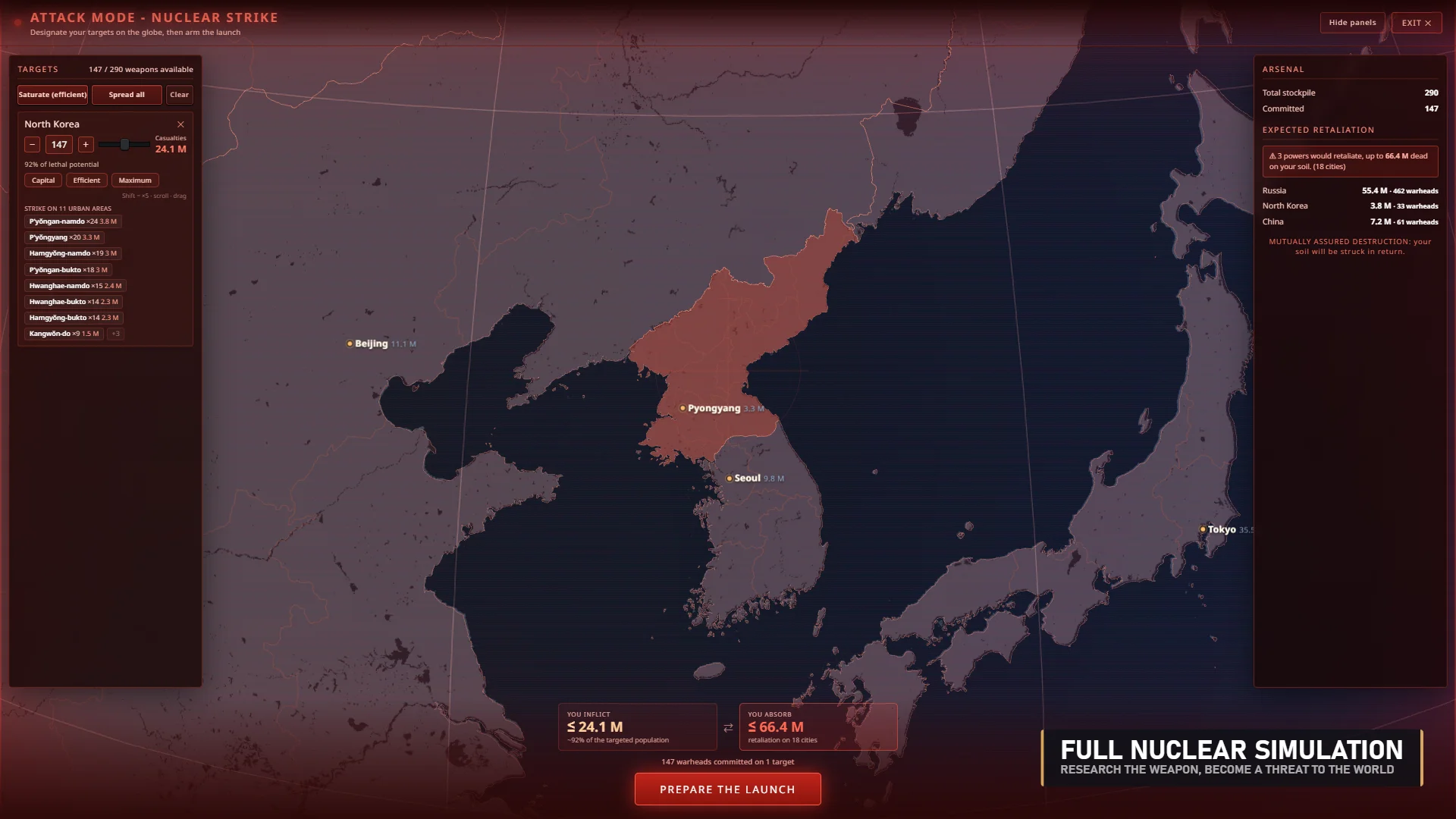
- Start a declared or clandestine nuclear-weapons programme.
- Fund the programme, pause it or abandon it.
- Rebuild a depleted nuclear arsenal.
- Decide whether to keep, dismantle or transfer a nuclear arsenal recovered after a complete conquest.
- Select target countries, allocate warheads and choose Major cities or Capital first before confirming a nuclear strike.
- Raise or lower the nuclear alert level, and choose your response if you are struck.
- Declare a nuclear doctrine, from No first use to Launch on warning, with consequences for relations and deterrence.
- Offer a nuclear umbrella to another country or seek a guarantor’s protection, with a non-proliferation pledge.
- Respond to an IAEA inspection by cooperating and dismantling the weapons programme, or refusing and continuing despite the international response.
- Follow the effects of nuclear strikes on sunlight, crops, fishing and solar power, including in countries that were never hit.
23 / Research
Choose how to acquire new technology
- Launch an independent national research programme.
- Acquire a licence, negotiate scientific cooperation or enter a joint industrial project; renew eligible agreements to resume the research they support.
- Inspect prerequisites and the effects of a technology before committing.
- Compare how starting another programme changes the completion estimates for research already underway.
- Stop a programme to free a slot while keeping its research progress.
- Follow the deployment of discoveries and research further generations once eligible technologies are sufficiently established.
24 / The Moon
Establish and govern a lunar colony
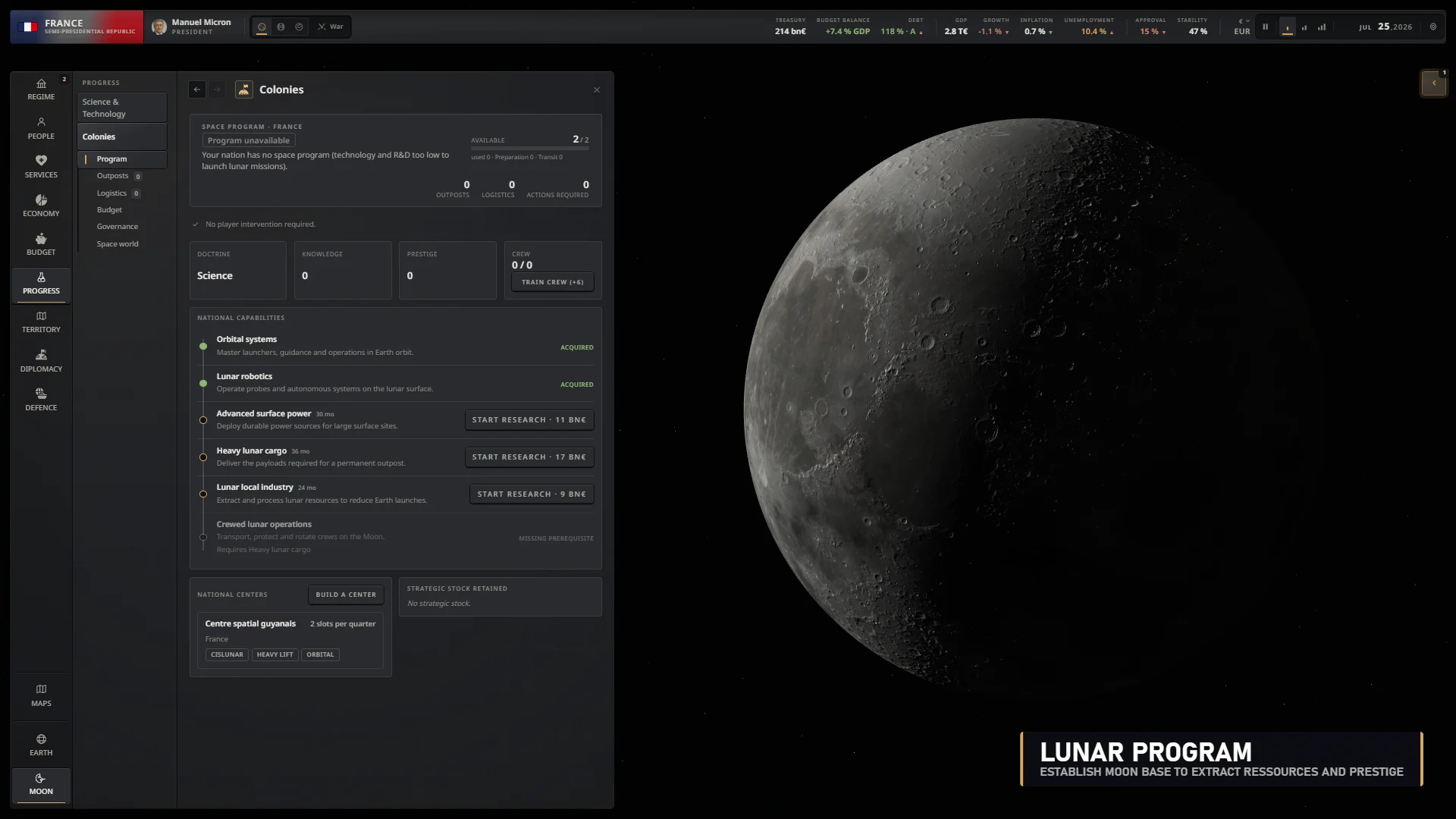
- Establish a site in an unoccupied lunar region.
- Build facilities and links between surface sites.
- Train crews and send them to a supplied, operational habitat.
- Send civilian settlers and follow their housing, employment and political demands.
- Build launch centres or request paid access to foreign launch slots.
- Follow automatic supply shipments and resolve shortages of funding, transport or storage.
- Extract resources, including helium-3, and arrange their return to Earth.
- Appoint governors and decide colonial charters and taxation.
- Respond to demands for autonomy, referendum requests and independence settlements.
- Fund space operators you sponsor with capital or loans, use their cash to repay debt and distribute available profits.
- Recognise independent lunar states, impose trade sanctions on them or lift your own sanctions.
FAQ
Questions about the game
The basics
Which countries can I play?
Why does a disputed territory belong to one country on the map?
On the starting map, a disputed territory goes to the state that administers it in practice. When no recognised state administers it, it goes to the state that claims it. This is a simplification for gameplay, not a statement on sovereignty or an endorsement of any claim or occupation. Some real-world disputes cannot be fully represented by the current mechanics. The game’s own notice on borders is in Settings → About.
When does a campaign start? Are there historical scenarios?
Every campaign begins on 1 January 2026, with the world as it stood that day: economies, public debt, populations and the war already under way in Ukraine. There are no historical start dates or scripted scenarios. What happens next comes from the decisions of countries, parties and people.
Are real politicians in the game?
No. The leaders of every nation are fictional characters. Parties are generated and anonymised, so they represent no real organisation. When a leader dies or is replaced, the game generates the people who follow.
Do Russia and Ukraine start at war?
Yes. Their war is already active when the campaign begins, with war goals and occupied territory. Playing either country means taking over the ongoing conflict. Ukraine also starts with financial-support programmes from several countries, while sanctions against Russia are already in force. Supporting countries are not automatically combatants, and their support can change as the campaign develops. Support and direct involvement ↗
What do I choose when I start a new campaign?
Search for a country or click it on the globe, or take one of the suggested starts, from countries with room to breathe to countries where everything is urgent. Then choose to lead the government or one of the country’s other parties. Four game rules are also set there: whether AI-led states may start wars, whether AI nuclear powers facing an existential threat may strike first, whether natural disasters occur and whether new pandemics can appear. AI wars and natural disasters are on by default; nuclear first use and new pandemics are off. You can change them in Settings for the current campaign. Starting outside government ↗
Is there a way to win, or an end to the campaign?
There is no victory screen and no end date: you set your own goals. Losing an election or a confidence vote does not end the campaign. It ends only if your nation is annihilated: entirely annexed, or reduced to a tenth of its starting population. What happens after a defeat ↗
Do other countries act on their own?
Yes. Every government you do not control sets its budget, passes laws, reforms its institutions, imposes sanctions, proposes alliances and can go to war, against its neighbours or against you. Tensions can lead to red lines, military deployments, economic pressure and open conflict. Elections follow each country’s own calendar.
Is there mod support?
Yes, for how the world looks rather than how it plays. Mods can rename leaders and parties, give leaders new portraits, replace a country’s flag or add new flags to choose from. The rules, the economy and the way other countries behave stay the same.
Build your own in the Mod studio from the main menu, or subscribe to other players’ mods on the Steam Workshop. Both appear in Manage mods and load when the game starts; turn one off and the original names and flags come back. Larger conversions, such as alternative historical starts, are unlikely: everything in the simulation depends on everything else. Without any mod, you can still rename your nation and draw or import its flag from Overview → Nation. Make a mod ↗
Playing & settings
What happens if I lose an election?
You keep leading your party. If the result removes you from government, choose to continue in opposition, take the lead of the party now in power, or play as someone else in the same world. Losing a parliamentary majority does not necessarily remove you from the presidency: the country’s institutions determine which powers you keep.
Do I have to start in power?
No. You can start in government or choose a party outside it. In opposition, raise funds, recruit activists and campaign while the government acts on its own. If your party has seats in a chamber with legislative powers, it can also sponsor bills, at a cost in influence. You still need the votes to pass them. Preparing an election campaign ↗ Proposing a law ↗
Can I change who I play during a campaign?
Yes. From the pause menu, choose another country and political party, including a party in government or in opposition. The campaign continues from the same world and date.
Can I pause the game to plan my next move?
Yes. Press Space to pause or resume. The number-row keys 1, 2 and 3 select the three simulation speeds. Opening the pause menu with Escape also stops the clock.
Can I save before a risky decision and come back to it?
Yes. Open Save from the pause menu and create a named save. You can keep separate saves or choose an existing one to overwrite, with confirmation. Use Load to return to the saved campaign.
Does the game autosave?
Yes. In Settings, choose an autosave every 1, 3, 6 or 12 in-game months, or turn it off. You can keep 3, 5 or 10 autosaves. Manual saves remain available separately.
Can I change the game’s language?
Yes. Choose your language from the main menu or Settings. You can also change it during a campaign.
Can I make the interface easier to read?
Yes. Settings let you enlarge the interface and choose colour-vision modes for red–green or blue–yellow distinctions, or a monochrome mode.
Can I adjust the graphics and sound?
Yes. Choose a graphics preset, texture quality, render resolution and frame-rate limit, switch between fullscreen and windowed play, and adjust brightness and gamma. Master volume, music, sound effects and the news anchor’s voice are set separately, and breaking-news broadcasts can be turned off. You can also change how quickly the camera rotates and zooms.
Power & people
Why am I short of influence when my party has money and activists?
They are separate resources. Fundraising adds money and recruitment adds activists; neither directly restores influence. Each month, influence moves towards a level set by your party’s support and cohesion. Keeping promises also restores it, while breaking them costs influence. Check the cost before launching another campaign operation, bill or no-confidence motion. Party resources and campaigning ↗
Can I talk directly to political leaders?
Yes. Through Cablegram, ask an opposition leader to support a bill, seek a foreign leader’s backing for a UN vote, or appeal for a peace review. They can accept or refuse, and your personal relationship matters. An accepted request can change a party’s voting line or secure a voting pledge. You can also ask your ministers for advice on their portfolios.
Can Parliament actually stop me getting my way?
Yes. Bills need the support required by your country’s institutions. You can inspect voting forecasts, follow debates and set your party’s voting line. Even after Parliament passes a bill, executive assent or judicial review can remain part of the procedure. How a bill becomes law ↗
Can I change the rules of elections themselves?
You can propose changes to electoral rules, term lengths, term limits and the way the head of state is selected. Constitutional choices depend on your country’s institutions. You can also call early elections when your office has that power. Politics and institutions ↗
Can I change who inherits the throne?
As the reigning monarch in an executive or absolute monarchy, you can change the rules of succession by royal decree. Replacing the heir this way can create a rival claimant and cost public support and stability. Royal decrees also let you change the Crown’s powers.
What happens when a monarch dies?
Succession happens automatically under the country’s inheritance rules. The royal family view lets you explore the family tree, the heir and the line of succession. If the new monarch is under 18, a regent takes over their duties.
What am I actually in charge of?
Your powers depend on the offices your party holds and the country’s institutions. In government, you can manage public finances, negotiate abroad, direct the armed forces and set policies. In opposition, you organise your party, campaign and use the parliamentary powers available to it. Explore the decisions ↗
Can I try to bring down the government from opposition?
Yes. If your party holds seats and the constitution allows it, you can table a no-confidence motion. Check the voting forecast before committing. Some systems also require an alternative majority capable of forming a government. Tabling a no-confidence motion ↗
How can I tell what needs attention in my government?
Open Cablegram, select one of your ministers and choose Ask for advice. Their reply includes an assessment of their portfolio and a recommendation. Use Open file to reach the relevant screen. You decide whether to act on the advice.
Why are elections happening at different times?
Each chamber and elected executive office has its own timetable. A legislative vote can take place during a president’s term. Some chambers renew all their seats together; others renew only a fraction at each election. Assembly shows upcoming dates, while Institutions explains the renewal rules. Chambers and election calendars ↗
Can I stay president if another party wins Parliament?
Yes, where the presidency and government are separate. A parliamentary election can install a different government while the president remains in office. The constitution determines which powers each side holds. Who governs after an election ↗
Does the party with the most seats always form the government?
Not necessarily. Where government depends on Parliament, the game resolves coalition formation and any required investiture after the election. Parties need compatible partners and sufficient support; a minority or caretaker government is also possible. Seats, coalitions and majorities ↗
Can I make campaign promises and then fail to deliver?
Yes. Announce up to three commitments on laws, taxes, spending or electricity capacity, with targets to meet. The game tracks progress during the mandate: fulfilled promises improve party credibility and influence, while broken promises damage them. Announcing a policy does not implement it. Build and defend a platform ↗
Can I abolish the upper chamber or change Parliament’s powers?
You can propose adding or removing an upper chamber and reform Parliament’s powers, executive vetoes and judicial review. These changes follow the relevant constitutional procedure and depend on your authority and the support required. Reforming the constitution ↗
Migration & communities
Can I raise or lower immigration into my country?
When governing, you can change the annual cap on regular immigration. The law card shows capacity and actual admissions. A higher cap creates room for arrivals; it does not guarantee that people will move to your country. Changing admission rules ↗
Can I change how asylum seekers are treated?
Yes. You can propose a set of asylum rules covering access to protection, the right to appeal and detention limits. The law card tracks pending claims and how many were granted or rejected. Immigration and asylum ↗
Can I see whether my country is losing skilled people?
Yes. Demographics compares arrivals and departures by age and qualifications. When people leave, you can inspect the social groups involved and their main destinations, alongside the overall migration balance.
Can I follow the communities and diasporas in my country?
Yes. Communities shows population shares, integration and naturalisation, alongside your country’s diaspora abroad.
Society & security
Why do some unemployed people receive no unemployment benefit?
Benefits do not cover everyone without a job. Eligibility, waiting periods, formal employment and exhausted entitlement affect coverage. Under Unemployment insurance, you can change the Replacement rate, Maximum duration and Access to benefits. Compare the projected coverage and cost before submitting the law; the beneficiary population changes over time. Changing unemployment benefits ↗
Can I protect pensions from inflation or support retirees without a pension?
Yes. Pension indexation lets existing pensions follow prices or wages. Old-age minimum provides a separate payment to retirees outside the ordinary pension scheme, with its own indexation rule. These are law changes: choosing a value does not enact it. Indexation affects future adjustments; it does not automatically make up for earlier losses. Pension and benefit rules ↗
Can I choose which families receive child benefit?
Yes. Set the monthly Child benefit, the qualifying age and means-tested or universal eligibility. You can also index payments to prices or wages. The law preview shows the covered children and annual cost. Changing eligibility or the age limit creates no payments while the benefit is disabled; the proposed law still needs to be adopted. Changing family benefits ↗
Why did reported crime rise after I changed policing policy?
More victims may be reporting offences. Community policing can improve trust and reporting, so recorded incidents can rise without an equivalent rise in underlying crime. In Security & Justice → Police, compare Estimated reporting rate, case clearance and the explanation beside the incident figures before changing policy again.
Does universal school access create enough places for everyone?
No. It widens access and reduces inequality, but schools still need teachers, buildings and operating funds. If capacity falls short, learning can suffer. Targeted support concentrates help, while Merit-based selection restricts access and favours the results of admitted students. Compare the preview before confirming: education policies phase in over a year and cannot be changed again for two years. Staffing public services ↗
Why can’t I change an administrative policy after its transition ends?
Full effect and the next permitted change are separate dates. A civil-service reform takes 18 months to phase in but commits you for four years; territorial organisation takes two years and commits you for five. Other administrative policies have shorter commitments. The confirmation shows the next change date before you adopt the policy.
Could I push for a shorter working week or earlier retirement?
Yes. The legislation system includes working hours, paid leave, the minimum wage and retirement age. Choose the change, check the balance of support and submit it through the applicable procedure. Raising the retirement age changes future retirement entries; it does not send people already retired back to work. Proposing a law ↗
Can I legalise drugs and choose how they are sold?
Yes. Cannabis can be prohibited, decriminalised, restricted to medical use or regulated. Other controlled drugs have separate options, including a state monopoly or a licensed market. You also choose how users are treated and whether enforcement targets trafficking routes, organisations or criminal finances. The Drugs screen tracks legal sales, tax revenue and the remaining criminal market. Changing the law ↗
Can I infiltrate a terrorist group and capture its members?
You can investigate an organisation, build an infiltration network and target its finances, weapons or logistics. Track identified members, then attempt a capture once your intelligence establishes who and where they are. You authorise the operation and follow its report; success is not guaranteed. Intelligence operations ↗
Can I choose who gets healthcare?
You can choose universal coverage, social insurance, a regulated mixed system or targeted coverage. You also set care priorities and prevention strategies. Wider coverage reduces financial barriers but can bring more patients into waiting queues; emergency priority draws resources away from other care. Policy changes take time to phase in and commit you until the date shown before confirmation. Health and public services ↗
Can I see which parts of society are struggling?
Yes. In Society, open a social group to compare income before and after tax, wealth, satisfaction and militancy. Groups react differently to living costs, unemployment, housing and public services. Understanding social groups ↗
Can I negotiate with unions instead of letting a strike drag on?
Yes. Meet the representatives involved in a dispute and offer a compromise or meet their demand. Compare each union’s response and the cost of the measure. An accepted proposal still needs to be implemented through the budget or legislation; the promise alone does not end the strike call. Negotiating a labour dispute ↗
Do strikes actually disrupt the economy and public services?
Yes. Workers on strike reduce the labour available in the affected sectors and public services. Labour relations shows the workers involved; choose View disruption to inspect the movement and its effects.
Will rent controls lower everyone’s rent straight away?
No. Regulation affects covered contracts and spreads as they turn over. The housing screens distinguish the market rent from the rent households actually pay. Rents and housing policy ↗
Can I protect homeowners from a sharp mortgage-rate reset?
Yes. Capped resets limit increases at future scheduled resets of eligible mortgages. Existing fixed-rate contracts and purely variable-rate loans keep their own terms. Mortgage protection ↗
Can I raise public-sector pay or protect it from inflation?
Yes. Set pay against comparable private-sector jobs, then choose whether wages cover none, half or all of future price rises. Apply the budget to adopt these changes. Pay affects recruitment, but filling vacant posts takes time and depends on the workers and qualifications available. Staffing and pay ↗
Why doesn’t building hospitals clear the waiting lists?
Buildings are only part of capacity. Hospitals also need staff, operating funds, medicines and equipment. In Health, check the bottleneck shown and compare installed beds with usable beds. Staff qualifications, fatigue and the number of patients needing care also affect how much treatment gets done. Hiring and funding staff ↗
Can my country suffer a famine even if it produces food?
Yes. Domestic production alone does not tell you what reaches households or what they can afford. Health → Food tracks shortages, hunger and dependence on foreign suppliers. Imports can fail, harvests can fall and rising prices can put food out of reach. Grain reserves can cushion a disruption, but releases use existing stock and take effect at the next monthly settlement. Food shortages and reserves ↗
Can I reduce prison overcrowding without building more prisons?
Check how much of the prison population is awaiting trial. In Security & Justice → Prisons → Related laws, Maximum pretrial detention lets you change that limit. Shortening it can reduce pretrial detention; it does not release convicted prisoners or clear the courts’ pending cases. Court capacity and the prison regime remain separate decisions.
Can I choose faster courts even if that creates more mistakes?
Yes. The Reduce delays doctrine increases processing capacity but raises procedural-error risk. Due process guarantees favours quality and trust at the cost of monthly capacity. A doctrine change takes six months to reach full effect and commits you to the choice for one year.
Do I have to choose between easier benefit access and stricter checks?
Yes. Automatic access favours speed and coverage, with more targeting errors. Means testing improves targeting but slows processing and reduces coverage. Local service desks improve territorial access but need more staff.
Can sending in the police make a protest worse?
Yes. You can facilitate and protect a protest, contain it, disperse it, order an armed crackdown or deploy the military. Stronger coercion can cause casualties and increase political pressure. Review the available forces and risk estimates alongside the movement’s demands. Responding to a protest ↗
Can a new pandemic break out during my campaign?
Yes, if New pandemics is set to Possible, when you start the campaign or later in Settings. It is off by default. A new pathogen can then appear somewhere in the world, roughly once every 25 years, from one of four virus families: coronaviruses, a new influenza A subtype, henipaviruses or filoviruses. It first shows up as an unidentified syndrome, gets a provisional name once a country identifies it, then official names a month later, such as SARS-CoV-3 for the virus and COVID-31 for the disease. Several can circulate at the same time. Some burn out; others, whose immunity wanes, can become endemic. The vaccine race ↗
What do I gain by discovering a vaccine first?
Your country can start vaccinating as soon as its laboratories find the vaccine. Other countries can use their own discovery too; worldwide availability comes 180 days after the first discovery. Once that first vaccine exists, other countries’ research progresses twice as fast. Your research target follows the most serious outbreak in your country’s reported figures, so it can change during the race. Vaccine research and availability ↗
Does a vaccination campaign take staff away from other care?
Yes. Mobilising more health workers speeds up vaccination but reduces the staff available for other care. Check that trade-off before launching, especially when hospitals are under pressure. You can stop a campaign early without undoing doses already given. Running a vaccination campaign ↗
Do I have to wait for a review before ending restrictions?
No. You can choose a lower tier or No measures under Public health measures in Health → Epidemiology, confirm and check when the change takes effect. The review after 28 days of strong measures is a reminder to reconsider them; it does not end them automatically or lock you into keeping them. Changing health measures ↗
Can I close my borders to an outbreak?
Yes, with targeted health borders rather than a blanket closure. A country joins your at-risk list on its own when its published figures show an epidemic, or any reported case of a new pathogen, and leaves it 21 days after things calm down. You choose stricter checks or suspended entry, for arrivals only or departures too, and can exempt an ally or include a country you distrust. Fewer travellers means less tourism revenue, and countries whose entry you suspend hold it against you. Set health borders ↗
Money & business
Why can’t I withdraw the full value of my sovereign wealth fund?
Fund value includes investments and foreign currency, not just cash you can spend. Withdraw to the Treasury uses domestic currency cash only. To sell eligible shareholdings, switch Automatic management to Manual, then use Stock market. Sales settle at month end as buyers allow, so the full amount may not arrive at once. Withdrawing and investing fund cash ↗
Does creating my own currency get rid of my existing debt?
No. Existing debt keeps its original currency, so repayments become foreign-currency obligations. The new currency starts at the same value as the old one, then floats. The preview shows the resulting foreign-currency debt share before you confirm. Creating a national currency ↗
Can I tax high incomes differently and treat essential goods separately?
Income-tax brackets have a detailed editor. VAT has different rates and product categories, so individual products can receive different treatment. These changes join the same budget proposal as your other tax and spending edits. Taxes and budget reforms ↗
Can I borrow to fund my plans instead of raising taxes?
Yes, if investors will lend to your country. In Budget → Summary, choose an amount and review the quoted rate, additional annual interest and treasury balance after borrowing. You can also repay debt from available cash. Borrowing and repayment are separate from applying tax or spending changes. Borrowing and repaying debt ↗
Can I rescue a bank without nationalising it?
Yes. Recapitalize only restores capital while leaving ownership unchanged. Recapitalize and nationalize also makes the bank state-owned. A solvent bank short of liquidity can instead receive a central-bank loan; that loan does not replace missing capital. Bank rescue and liquidity ↗
What can I do when a company runs into trouble?
You can finance corporate investment, reorganise a distressed company or liquidate it. The finance screens also let you buy foreign equity through the sovereign fund and close or reopen the stock exchange. Companies and investment ↗
Does a higher tax band apply to someone’s whole income?
No. Each marginal rate applies only to income inside that band. You can also set a personal allowance and choose whether thresholds follow wages, follow prices or stay frozen. In the income-tax editor, Test a household shows the calculation before you apply the budget. Tax bands and indexation ↗
Can I tax wages and capital income differently?
Yes. Labour income uses the tax bands after the applicable deductions and personal allowance. Capital income can join those bands, face a separate rate or be exempt from this tax. Compare the effects on social groups before applying the whole budget proposal. Income-tax rules ↗
Can I nationalise a sector or turn it into cooperatives?
Yes, where ownership rules allow it. You can increase the State’s share, sell public stakes or transfer eligible unlisted private stakes to employees. Choose how much to transfer and review the price and consequences. Nationalisation offers market-price buyouts, negotiated buyouts or seizure where permitted; cooperative transfers are paid for by the State. Changing sector ownership ↗
Can I change what employers and employees pay in social contributions?
Yes. Set employee and employer contributions separately, cap the pay assessed for each, and reduce employer contributions on low wages. The relief tapers off as pay approaches your chosen threshold. Test a salary compares employer cost and pay after contributions but before income tax. These changes take effect when you apply the budget. Editing contributions ↗
Can I print money to fund the government?
Yes, when your monetary system allows it and the central bank is under government control. In Budget → Summary → Emergency measures, choose Create money and review what the Treasury actually receives, the extra debt and the loss of monetary credibility. Printing raises prices; an IMF programme can prohibit it. You can later use Treasury cash to Repay the central bank, withdrawing that money from circulation. Money creation and repayment ↗
Can I choose to default on public debt?
Yes. Under Budget → Summary → Emergency measures, Suspend debt repayments lets you review a default before confirming it. Part of the debt is written off, but borrowing closes and creditors—including domestic banks—take losses. The Treasury keeps its cash. Once that buffer runs out, the state cannot keep funding a deficit through the markets, so actual spending falls back toward what revenue can cover. Reviewing a default ↗
Can I see what my budget changes will cost before committing?
Yes. Compare current and projected revenue, spending and balance while preparing the proposal. Apply commits the package; Discard abandons the pending changes. Editing the forecast does not itself change the budget in force. Reading and applying a proposal ↗
Can I build up an industry to create jobs or rely less on imports?
Yes. Set up a productive-investment programme for a company, a specific good or an entire sector. Choose whether to produce more at home, sell more abroad, create jobs or reduce a critical dependence. Set a budget ceiling and duration, then review the proposed projects and their requirements before authorising the programme. Planning an industrial programme ↗
Do businesses hire and invest on their own?
Yes. Businesses can start expansion projects themselves when demand, expected returns and financing support them. Employment adjusts over time to production needs and the workers available. You can follow employment and investment projects in the economy and finance screens.
Can I set interest rates, or leave that to the central bank?
Where your country controls its monetary policy, you can set the policy rate yourself or restore central-bank independence and let it adjust rates automatically. Currency unions and exchange-rate arrangements can restrict direct control. Public finances and monetary policy ↗
Can I develop tourism as a source of income?
You can change visitor entry rules, fund promotion and set a visitor levy. In Economy → Tourism, entry rules are a separate decision; promotion and the levy use the shared budget draft and need to be applied. Follow visitor origins, spending and accommodation pressure. Safety, prices, transport and accommodation affect arrivals, so more promotion alone does not guarantee more revenue. Tourism and events ↗
Does all tourism income go to the Treasury?
No. Visitor spending pays tourism businesses; it is not all government revenue. Economy → Tourism shows foreign visitor spending separately from Visitor levy revenue. The levy rate shown can belong to your pending budget draft, while the revenue figure reflects the last calculation. Editing the rate does not immediately turn the displayed spending into tax receipts.
Can I host the Olympic Games or other major events?
Yes. Bid for an open Olympic hosting contest and follow the host vote. You can also organise cultural festivals, conventions and international championships, choosing their location and scale. Events need venues, funding and available security forces. Preparing an event ↗
Resources & infrastructure
Why isn’t all my oil or gas reaching export customers?
Check Transport → Open the Transport Room → Diagnose. Undelivered hydrocarbon exports identifies problems in your own network, a transit route, a strategic passage or the customer’s network. Exporting gas by tanker also requires liquefaction capacity; an ordinary port is not enough. Expanding your terminals will not fix every blockage abroad. Checking export routes and LNG capacity ↗
Will more storage or electricity imports fix a power shortage?
It depends on the cause. Storage helps recover wind and solar output that your grid cannot currently use. Imports depend on connections, trade rules and neighbouring suppliers; opening purchases does not build a line or guarantee supply. Check Electricity → Grid and Fuel reserves before committing to another project. Finding the bottleneck ↗
Can I restart an extraction site after closing it?
Stop suspends production and keeps the installation; Resume can restart it, subject to its condition. Close site removes installed capacity. The remaining resource stays underground, but extraction needs a new construction project. Neither action restores resources already extracted. Opening, stopping and closing sites ↗
Does the state pay for every new extraction site and keep all the revenue?
No. The quote identifies the company or state paying for construction and shows the Treasury contribution. Production and operating margins are not the same as government revenue: the public share depends on sector ownership, while taxes and company distributions are settled separately. The displayed estimate uses current prices, not a guaranteed return. Reading an extraction project ↗
Can I reduce my country’s dependence on oil, gas and coal?
Yes. After oil lets you support electrification of cars and trucks, building heat and industrial heat. You can also develop alternatives such as hydrogen-based steel and fertiliser, synthetic fuels and recycled chemicals. These need working power supplies, technology, equipment and time. Build hydrogen distribution capacity and choose which uses get priority when it runs short. Replacing fossil fuels ↗
How do I protect people from extreme heat and cold?
Open Housing → Buildings. Heating and cooling setpoints and the emergency response are saved with Apply setpoints. Renovation, cooling access, heat pumps and climate shelters have separate targets, pace and funding: save these with Fund the programs. Mobilization needs existing shelters, and new equipment takes time to arrive. Installed heating or cooling also needs energy to work. Weather and protection ↗
Does climate change affect the simulation?
Yes. The economy’s use of coal, oil and gas, along with cement production, feeds global emissions. CO₂ and temperatures evolve over time rather than changing instantly when you adopt a policy. Heat, cold and water stress can reduce crop yields. Open Climate to compare the global trend with your country’s emissions and world share. Other countries contribute too: reducing your emissions does not immediately reverse warming. Risks → Weather shows active weather episodes; After oil covers reducing fossil-fuel dependence. Climate and energy transition ↗
Can I take control of extraction rather than leave it in private hands?
Yes, through the ownership controls for the relevant sector, where the rules permit a buyout, seizure or privatisation. Site operations are separate: develop a deposit, stop or resume production, or close an installation. Closing removes its capacity; it does not transfer ownership or restore the resource. Changing sector ownership ↗
Can I keep resources in reserve for when I need them?
You can set strategic-reserve targets and monthly purchase budgets, then release stocks manually or select automatic releases during supply disruption or price stress. Purchases still depend on funds and supplies. Military stockpiles have their own targets, which you set through the armed-forces controls. Resources and reserves ↗
Do I get to choose where new infrastructure goes?
You can place power plants on the globe, build ports and airports, draw transport corridors and select provinces for infrastructure programmes. Schools, hospitals, police stations, courthouses and prisons also use provincial placement. Infrastructure and transport ↗
Can I decide who gets through a strategic passage?
For a passage under your control, you can open or restrict access and set military-transit rules. Port terminals and transport corridors are also manageable parts of the network. Passages and access ↗
Can I shut a power plant down and restart it later?
Yes. Existing plants can be stopped and restarted. You can also expand their capacity where available, or retire them through a separate decision that shows any decommissioning cost. Managing power plants ↗
Can I challenge OPEC’s production policy?
As an OPEC member, vote to cut, hold or raise production, then choose whether to respect your quota or overproduce. Eligible swing producers also have the option to start an oil price war; that power is restricted to the relevant members. Resources and oil policy ↗
Can I prepare for natural disasters, or only react afterwards?
Both. Fund hazard-specific prevention programmes and watch preparedness develop. When disaster strikes, choose the scale of the response and prioritise lives, national continuity or a balance of both. Follow reconstruction by province and contribute to another country’s recovery. Prevention and disaster response ↗
Diplomacy & intelligence
Can I send financial aid to a country of my choice?
In Diplomacy → Aid, select an eligible country under Recipients. Set Monthly amount under Bilateral aid, then select Apply. This is a recurring Treasury transfer, subject to available funds and aid limits. Stop this aid ends that commitment; Stop all ends your bilateral commitments. Neither changes Multilateral aid (budget), which is distributed across eligible countries. Military support is separate too.
Can I leave a trade agreement?
Yes. In Diplomacy → Agreements, open an active agreement and choose Withdraw from the agreement when available. Withdrawal takes effect after six months; the agreement still applies during the notice period. Leaving damages relations with the other parties. If your trade bloc signed the agreement, withdrawal needs collective approval. Negotiating and leaving an agreement ↗
Can an intelligence operation succeed and still be discovered?
Yes. Success and secrecy are separate outcomes: the objective can be achieved while your involvement is detected. Read both the result and exposure in the report. Extract the network can reduce exposure by giving up some access, but extraction is itself an operation with a cost and risk. Operations and exposure ↗
What can I do during a hostage crisis?
In Intelligence → Situation, choose between Negotiate, Stall, Order an assault and Meet the demand, then commit the mandate. An assault needs sufficient location intelligence and ready services. Stalling can improve intelligence but may cost lives; extensions are limited. A ransom is paid to the organisation, and a pending mandate cannot simply be replaced. Managing a hostage crisis ↗
Can I target arms or finances instead of cutting all trade?
Yes. In Diplomacy → Sanctions, select individual measures such as an arms or energy embargo, technology controls, an asset freeze or investment restrictions. Availability depends on your country’s leverage. You can add measures to an existing regime and change how strictly your country enforces it. Choosing and enforcing sanctions ↗
Can I resolve a diplomatic crisis without going to war?
You can propose a mutual withdrawal, but the other side must accept. If you opened the crisis, you can withdraw your demand. A neutral country can offer to mediate if both sides have sufficient relations with it. Giving in follows the actual demand; a ceasefire still needs the countries at war to agree. Negotiating a way out ↗
Can I squeeze a rival without declaring war?
You can impose sanctions, negotiate trade terms, commit foreign aid and offer military guarantees. Under Diplomacy → Crises, a dispute can lead to a red line, border mobilisation, naval deployment or patrol, maritime interdiction or economic pressure. Available measures depend on the issue, your forces and the reach of the action. You can also seek a settlement or withdraw your demand. Managing a diplomatic crisis ↗
Can I open trade in some products while protecting others?
Yes. Trade negotiations let you select individual products and set each side’s import-duty reduction. You can exchange counteroffers and phase reductions in over time. A 50% reduction halves a duty; it does not set a 50% tariff. Product-by-product negotiations ↗
Can I arrange military access without promising to fight every war?
Military access, non-aggression, defensive pacts and guarantees are distinct treaty choices. A defensive pact can include additional clauses such as intelligence sharing or offensive assistance. You can also negotiate foreign basing agreements. Treaties and their commitments ↗
Could my spies knock out a rival’s power supply?
Intelligence missions include disrupting a power grid and sabotaging an identified plant. Operations need preparation: build a network, learn about the target system and establish the required access. Review the briefing’s cost, duration and risk before authorising it. Preparing an operation ↗
Can I investigate someone spying on my own country?
Yes. You can investigate intrusions and run counterintelligence operations to purge or turn hostile access. Operation reports show the results and exposure; intelligence dossiers also provide actions against identified clandestine organisations and individuals. Intelligence and counterintelligence ↗
Can I vote on international crises at the UN?
When you govern a country on the Security Council, you can vote on the condemnation, ceasefire and sanctions resolutions before it. Review the draft and voting forecast, then vote for, against or abstain before the deadline. A permanent member’s vote against is a veto. A ceasefire resolution applies political pressure; it does not itself end the war. Reviewing and voting on a resolution ↗
Where do I change the general import tariff?
Open Budget → Revenue & taxes → Customs duties. A customs union may control this rate instead of your government. Agreements reduce the duty on covered goods; targeted measures add extra duties afterwards. Check the WTO ceiling and affected partners before applying a rise: exceeding the ceiling can open trade disputes. Tariffs and trade disputes ↗
Can I retaliate against another country’s trade measures?
Once consultations expire, Prepare response becomes available to the complainant in Diplomacy → Agreements → Measures. It opens a retaliatory act for you to review and apply. If the original measure is later withdrawn, your retaliation does not disappear automatically: it loses its basis and can trigger a dispute against you. Preparing a trade response ↗
Can I raise tariffs on selected countries or products?
Yes. In Diplomacy → Agreements → Measures, compose an act and choose its partners, goods and additional duties. Each clause can have its own notice period and duration. When a trade bloc controls these measures, you need its approval. Targeting goods covered by an agreement can trigger a trade dispute and damage relations. Targeted import duties ↗
Which international organisations are in the game?
Diplomacy → Organizations brings together the UN Security Council, the European Union and its central bank, OPEC, the IMF and the IAEA. NATO is a standing alliance under Defence → Alliances: when a member is attacked, each ally decides whether to enter the war, send military support, grant access only or refuse the call. Trade blocs such as USMCA, Mercosur, ASEAN or the African Continental Free Trade Area negotiate agreements as one party, and their members vote on the bloc’s mandate. Diplomacy and organisations ↗
Can my country win a seat on the UN Security Council?
Yes. When the Council election opens, declare your candidacy in your regional group and vote for the candidates you back. Voting takes place in rounds. The lowest-ranked candidate drops out until a candidate wins enough support or is the last one remaining. Elected members sit for two years alongside the five permanent members.
Can my country join or leave the European Union?
An eligible country can file an application once it meets the entry criteria on stability, inflation, debt, default and war. Negotiations advance only while you keep meeting them, and every member state must approve your accession. As a member, vote on candidates, propose changes to EU rules such as tariff powers or the treaty amendment rule, campaign in European elections and help appoint the Commission. You can also leave the Union, at a cost to your relations with its members. Applying for membership ↗
Does joining the EU automatically put me in the euro?
No. Adopting the euro is a separate decision for eligible EU members issuing their own currency. The game checks inflation, the deficit, debt and long-term interest rates. Review the conversion before confirming: debt issued in your old currency is converted, the ECB sets your policy rate, and you lose the ability to print your own currency. EU membership and the euro ↗
Can I ask the IMF for a bailout?
Yes, when your country faces a real crisis: foreign-currency reserves running short, lost market access, or a sovereign default. The first payment adds foreign-currency reserves and debt, and the first stage of the stabilisation plan applies when you sign. Later tranches depend on budget reviews. Loosening the budget too far beyond the signed plan can suspend payment; the budget screen warns you before a change would fail the review. Applying and following the programme ↗
War & territory
Why are my formations still understrength after equipment arrives?
Deliveries enter the national arsenal first. The general staff reinforces formations over time using available equipment and replacement personnel, with units at the front taking priority. Open Defense → Order of battle and expand a unit type to check its formations. Rebuilding a lost formation also needs enough personnel and equipment, followed by a formation period. From deliveries to equipped formations ↗
Can I capture another country’s nuclear arsenal?
After a country is completely conquered, the main conqueror may take custody of its remaining arsenal. Choose whether to integrate the recovered stock, dismantle it or transfer it to an available nuclear partner. Weapons at sea are excluded. Keeping recovered warheads can make your country a nuclear power and trigger a proliferation response; keeping fissile material alone does not. Deciding the arsenal’s fate ↗
How deep is the war simulation?
The front moves day by day between real formations. Terrain, supply lines, encirclement, air superiority and sea control decide where it advances, and a province counts as occupied only once most of its ground is held. Air forces fly patrols, strikes and close support from their bases; navies fight for control of the sea, and a blockade cuts maritime trade. Each side’s support for the war wears down with casualties, duration and lost territory, and a collapse can force defeat. Occupied provinces stop producing for their owner, so a war is felt in the economy as well as on the map. Preparing and directing a campaign ↗
Can I see how the world will react before declaring war?
Yes. The war council asks for your grounds: defence of an ally, a coercive operation, disarmament, imposing a political status or conquest. Each is rated from legitimate to aggression, and the cost at home rises with it. Before you confirm, review the provinces you claim, the countries expected to join the fighting, back the target or condemn you, where your ministers stand, and the expected loss of stability and approval, including any treaty you would break.
Do I move every army myself, or does the military handle that?
The general staff assigns units to sectors and carries out their movements and attacks. You set the campaign directive: Hold, Limited pressure or Major offensive, with changes available at the next monthly review. Across multiple fronts, leave theatre priorities on Auto or override them yourself. You still decide equipment orders, stockpile targets and amphibious assaults. Directing a campaign ↗
Can I strike a country without invading it?
Yes. A coercive operation is a limited air and missile campaign. Choose a targeting doctrine: suppress air defences, degrade missile forces, or hit energy or resources. Ground combat and naval manoeuvre stay outside the mandate. You can conclude the operation, or authorise an invasion to escalate to full war at a further political cost.
Can I buy equipment from other countries?
Yes. In Defence → Arsenal → Order, choose the equipment class and quantity. The game offers domestic production when possible, or an eligible foreign supplier when your country cannot make it or congested domestic lines would deliver later. You review the supplier, model, cost and production time before ordering; you do not pick the supplier yourself. Buying and producing equipment ↗
Why can’t I buy equipment when my defence budget is high?
Equipment is paid for from the military treasury. Part of its cash is protected for operations, so check Available for orders, not just the total balance or annual budget. The full purchase amount must be available and is reserved when you order. You can make a one-off transfer from the national treasury if it has enough cash. Funding an order ↗
Why hasn’t my equipment order arrived yet?
An order starts production, not an instant delivery. Factory capacity and existing orders affect the estimate, and units arrive progressively. Check the order’s status for an industrial or payment hold, sanctions, or a war with the supplier. Completed purchases go straight into your arsenal; they do not use the transport rules for military aid. Following production and deliveries ↗
Can I cancel an equipment order and get my money back?
You can cancel your purchase from the production center. Unspent funds reserved for that contract return to your military treasury. Equipment already delivered stays in your arsenal, so cancelling does not refund the whole original purchase after deliveries have begun. Managing equipment orders ↗
Can my country produce military equipment for export?
Yes. Other countries can place orders with your industry when it is an eligible supplier. The production center separates National, Import and Export orders so you can see who the production is for. An export contract manufactures equipment for its buyer; sending equipment you already own is handled through military support. Domestic and foreign orders ↗
Why are my troops short of ammunition when my reserves are full?
The national depot and supplies carried by units are separate. Click a unit on the military map and check Ammunition endurance. Resupply draws from the depot but is limited by logistics; isolated units cannot receive it. Raising the depot target buys more ammunition over time, but does not remove those limits. Reserves and unit supplies ↗
Do I have to keep ordering ammunition and missiles myself?
Set their separate Depot target controls in Defence → Arsenal → Equipment. Ammunition uses days of combat reference coverage for the depot; the missile target counts missiles both in storage and with units. Outstanding orders also count towards the missile shortfall. The administration orders the shortfall as funds allow, but the stock only grows when deliveries arrive. Production can also supply foreign buyers, so check Deliveries received rather than domestic production alone. Keeping reserves supplied ↗
Can I pursue nuclear weapons in secret?
You can start either a declared or a clandestine nuclear-weapons programme. Fund it, pause it or abandon it, and rebuild a depleted arsenal. A clandestine programme can become suspected or exposed, so secrecy is part of the risk. A clandestine programme started under the Non-Proliferation Treaty can prompt an IAEA inspection. In Diplomacy → Organizations → IAEA, check the deadline and choose Cooperate and dismantle or Refuse and continue. Ignoring the deadline counts as refusal: the programme becomes public and triggers the international response. Cooperation abandons the programme; only its unspent reserved funds are returned. The nuclear programme ↗
Can I change my country’s nuclear doctrine?
Yes, if your country has nuclear weapons. Choices include No first use, Extended deterrence and Launch on warning. Your declaration can affect relations, the credibility of your guarantees and the scale of a massive retaliation. Changing doctrine commits you for a year. Launch on warning also requires a high enough alert level to offer a response before impact. Doctrine and alert levels ↗
Can I seek nuclear protection without building my own weapons?
Yes. A non-nuclear country can request a Nuclear umbrella, and a nuclear power can offer one. The partner must accept; an AI guarantor requires an existing defence commitment. The agreement includes a non-proliferation pledge. Its credibility depends on the guarantor’s arsenal, doctrine and commitment, so retaliation is not guaranteed. Making your weapons programme public breaches the pledge and may lead the guarantor to withdraw. Negotiating nuclear protection ↗
Can I take over land left behind by a collapsed state?
Yes, where territory has been left without a government. Select it on the map and choose Expand into this land. You need a land border and the authority to expand. Progress is gradual and other neighbours can compete; you can choose Stop expanding. This adds territory to your country rather than restoring the former state. Devastated territory ↗
What happens if nuclear weapons are used?
In the nuclear war room, choose targets and allocate warheads while the projected retaliation is shown. A first strike severely damages your stability, approval and relations with every country, and the target and its guarantors may retaliate. If you are struck, choose your response, from holding back to massive retaliation. Strikes kill, destroy infrastructure and housing, and send soot into the atmosphere. Reduced sunlight and cooling can affect crops, fishing and solar generation even in countries that were never hit. These effects develop over time; the launch preview is not the final outcome. By default, AI powers only fire in retaliation; a game rule can allow them to strike first when facing an existential threat. Launches and consequences ↗
If I occupy a province, can I keep it after the war?
You can demand annexation of occupied provinces covered by your declared territorial war goals. The peace screen lets you select eligible provinces and evaluate whether the other side will accept. Occupation gives military control; the agreed settlement transfers sovereignty. You can also negotiate a ceasefire or an armistice. War and peace ↗
What happens to civilians in the provinces I occupy?
Choose how each occupied area is run: administer, repress or expel. Repression weakens resistance but kills civilians; expulsion drives the population out. Hostility can build from calm to open revolt, and the world watches how you treat civilians: harm done to them damages relations and can bring sanctions. Fighting also kills civilians near the front and forces people to flee, some of them abroad.
Can I buy a territory instead of invading it?
Yes. In Political Status, negotiate the purchase or cession of an entire territory with its own administration. Choose a price and proposed status. The affected authorities must agree, and changing sovereignty requires a referendum. Status negotiations also let you propose autonomy or independence where your authority allows it. Negotiating political status ↗
Can I stop the fighting without giving up my territorial claims?
You can propose a ceasefire or an armistice. If accepted, fighting stops while forces hold their positions; sovereignty does not change. Fighting resumes automatically when a ceasefire expires; an armistice has no automatic end date. Breaking an active agreement damages relations and domestic support, and breaking an armistice also costs stability. A final territorial settlement is a separate peace agreement. Ceasefires and peace negotiations ↗
Will my allies fight alongside me?
Defence treaties trigger a call when a covered ally is attacked; they do not guarantee that every member will fight. Each ally can enter the war, send military support, grant access or refuse. If you lead your side, Call allies also lets you ask allies to join voluntarily, including in a war you started. Their government can refuse. Defence calls and voluntary participation ↗
Can I support a country without sending my own forces into its war?
Yes. Offer monthly funding, equipment from your stockpiles, or both. An accepted programme makes your country a supporter without directly committing it as a combatant. Embargoes and supply routes can interrupt equipment deliveries. You can also request support when your own country is fighting. Sending and receiving military support ↗
Can I end an overseas base agreement or expel a foreign military presence?
In Defense → Alliances, use Terminate for your presence abroad or Evict for a foreign presence you host. This starts a notice period, and rent remains due until the agreement ends. Ending it also has diplomatic consequences. Negotiating and ending a basing agreement ↗
Can I build military bases abroad?
Yes, with an active basing agreement. In Defence → Bases → Open the base room, choose the type, size and an authorised location. The agreement limits military domains and capacity. Naval bases require a coastal location; logistics, air defence and shelter hardening are added to an existing base.
Can I negotiate autonomy or independence without fighting a war?
Yes, for eligible territories when your authority allows it. Political Status lets you propose autonomy, independence or integration, exchange counteroffers and inspect local support. The affected authorities must consent, and changes such as independence or sovereignty transfers require a referendum. Negotiating a territory’s future ↗
Research, the Moon & cheats
Who pays when a space operator borrows money?
In Space → Budget, Borrow lends your country’s money to an operator you sponsor. It needs available public funds and creates an interest-bearing loan the operator must repay. Repay uses the operator’s cash. Pay a dividend distributes available profits to its owners; it cannot turn an empty cash balance into income.
What happens if a lunar shipment cannot be delivered?
Open Space → Logistics and inspect the reason and deadline. An arriving mission can retry or return to Earth; the return takes time and does not refund the mission. Returning freight can be recovered, but construction modules are lost. A stuck surface shipment needs an open route to return and can be lost if none is available by its deadline. Abandon cargo permanently discards a surface shipment. Resolving held shipments ↗
Do satellites have a military use?
Yes. Your military satellites provide navigation coverage that makes air support more effective. In Defense → Satellites, check Navigation (precision) and Strike precision, then use Arsenal to order more. The benefit follows equipment actually delivered; placing an order does not increase coverage immediately. Ordering military equipment ↗
Can another country help me develop a technology?
Yes. A licence, scientific cooperation or a joint industrial project can speed up your research. Signing the agreement does not unlock the technology: you still need to launch and complete a programme. The partner must already know the technology, and relations, prerequisites and technology embargoes determine which agreements are available. Research and partnerships ↗
Why hasn’t a discovery delivered its full benefits yet?
Economic benefits spread as the technology enters use across the country. Researchers, institutions and digital infrastructure limit how widely it can be adopted; equipment renewal and electricity supply also affect the pace. Check National deployment and compare Current with At full deployment in the technology’s details. Some discoveries unlock a capability directly rather than spreading this way. Following a discovery ↗
Can I keep improving a technology after discovering it?
Some technologies that improve production or labour efficiency have further generations. Next generation shows whether another programme is available or how much deployment is still needed. Later generations use a Sovereign program, occupy a research slot and bring additional gains that also spread over time. Researching another generation ↗
Is the Moon something I can actually build on?
Yes. Establish a site in an unoccupied lunar region, build facilities and surface links, and send trained crews. Sites can extract resources and arrange their return to Earth. Lunar sites and missions ↗
What has to be ready before I send a crew to the Moon?
You need crewed-spaceflight capability, trained crew, enough power and room at the destination. Habitat and life support must be ready; facilities on standby in an empty base also qualify. The supply forecast must cover at least three months, counting the arriving crew and the provisions they bring. Preparing a crew mission ↗
Does a lunar colony have its own political life?
Yes. In Space → Governance, appoint governors, set taxation and use Charter to choose an advisory council, budget powers or legislative powers. Residents can seek autonomy or independence. Granting autonomy gives the colony elected leadership and legislative powers that you cannot simply take back through the charter. Governing a lunar colony ↗
Does a successful lunar referendum automatically create an independent state?
No. After a vote for independence, you still decide whether to conclude the settlement. Review the terms in Space → Governance: the transfer requires operating capital from your country. Before a request can arise, the colony also needs to meet its civic and economic conditions; subsidies alone do not count as local earned income. Once the settlement is concluded, the new state takes control of its government and sites. Autonomy, referendum and settlement ↗
Can my lunar outpost become a civilian settlement?
Yes. Send settlers brings permanent residents, separately from the astronauts sent with Send a crew. The destination needs free housing, working life support, enough power and supplies for the arrivals. Residents have jobs, incomes and political demands. Follow the requirements shown for settlement before sending another group. Crews and civilian settlers ↗
Do I have to send every supply shipment to the Moon myself?
No. Outposts automatically arrange deliveries of food, breathable gases and spare parts when their reserves need replenishing. Those deliveries still require money, launch access, transport capacity and room in storage. In Space → Outposts, check Resupply and any Resupply blocked message, then follow the shipment in Logistics. A severe shortage can lead to an evacuation; automatic resupply is not a guarantee of survival. Keeping an outpost supplied ↗
Do I need my own launch centre to reach the Moon?
You can build a centre or request launch slots from an eligible foreign provider. Foreign access has an annual fee and needs the provider’s agreement; it does not replace the required space technology. Review offers and contracts in Space → Logistics, or use Build a center in Program. A full launch window queues a prepared mission until capacity is available. Preparing launch access ↗
What is lunar helium-3 actually used for?
Helium-3 fuels experimental and commercial fusion reactors on Earth. You need to extract it, keep the lunar site supplied and arrange its return; stock on the Moon cannot fuel an Earth-based reactor. Bringing it home does not automatically earn money or add electricity. It stays in physical storage until it is used or sold. Mining, returning and using helium-3 ↗
Does researching helium-3 fusion let me build power plants straight away?
No. Complete the required fusion and helium-3 technologies, then build the experimental reactor in After oil. It needs 24 months of actual operation, with helium-3 and other operating supplies, before commercial helium-3 reactors become available. You can return lunar helium-3 or buy an available Earth-based supply. Commercial plants still need construction, fuel and running costs. Proving and supplying a fusion reactor ↗
Are there cheats if I just want to experiment?
Yes. The game includes console commands to add money or military equipment, set your stability, complete or speed up research, speed up construction, finish projects, shock your currency's prices, change territory, trigger a natural disaster, start an outbreak or make a new pathogen emerge. A successful cheat permanently disables Steam achievements for that campaign, even if you later turn it off. Help and display commands do not disable achievements. Console and cheats ↗
What happens if I pull the plug on a research programme?
The progress already made is kept, even if the technology has not been discovered yet. Stopping a programme frees its slot. Research capacity is shared automatically between programmes that can progress, so you prioritise by choosing which ones to run. Managing research programmes ↗